
Menu
  • Home
  • Projekte
  • Videos
  • Blog
  • Person
  • Galerie
  • Events
  • Master Research

saraw

21/33 Halleluja Junction – 1st Movement

4. Januar 2022 by SaraW
Master Research

Take a listen:

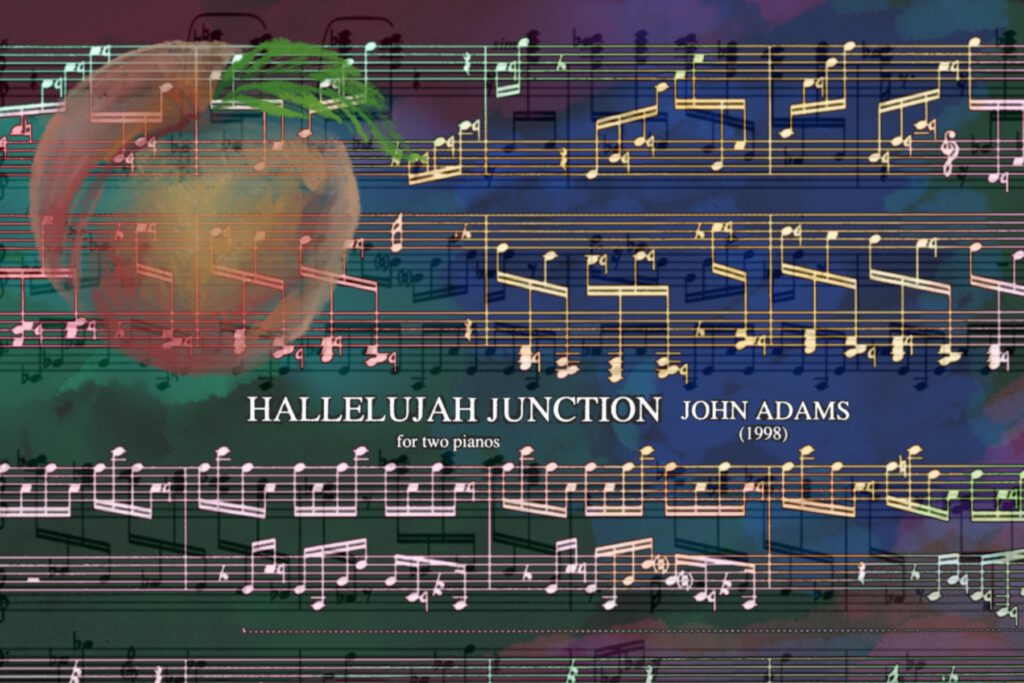
To tackle the task self-assigned in the last post, I have chosen a piece by John Adams for two pianos – Hallelujah Junction Movement 1. For me, it belongs to the category of pieces that make me feel like I am in a very sheltered comfort zone. The minimalistic approach of the composition evokes trance-like states and is equally driven by the element of tension and release. 

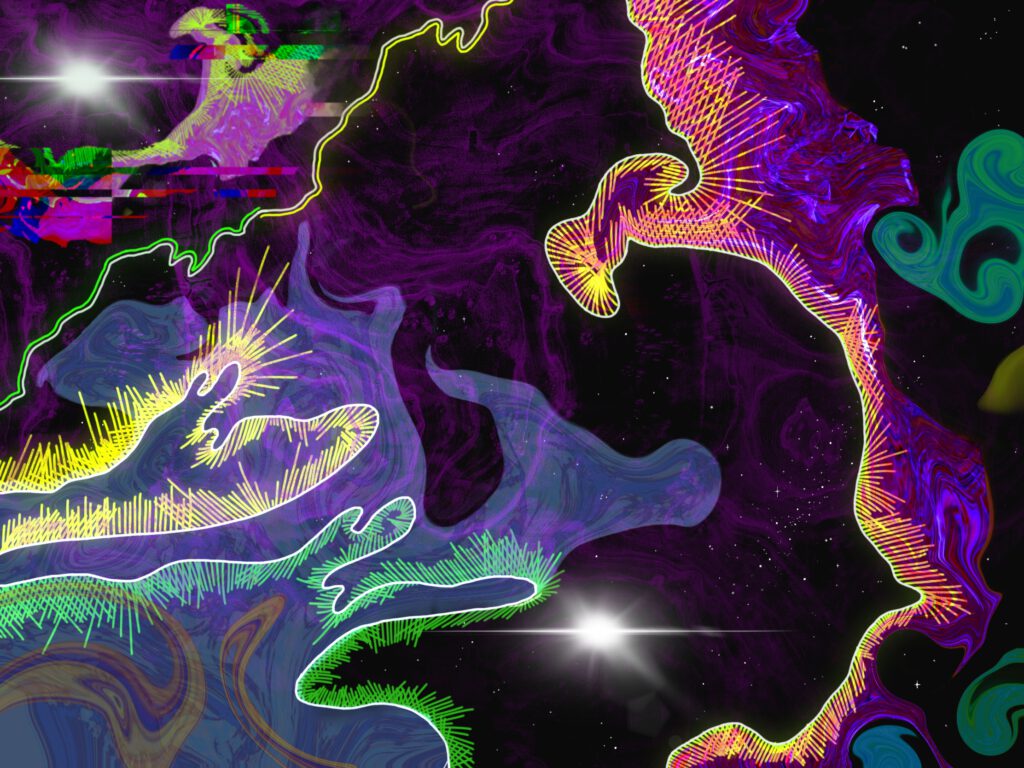
In my drawing, a repeatedly appearing colored line on a dark background serves as a projection surface for the repeated initial sequence. It changes from time to time, reappearing slightly offset next to the previous line. 

According to my subjective feeling, the wavy basic structure of the main motif draws a long arc of tension until minute 4:15. At this point the piece frees itself from the unstoppable stream of the minimalistic pattern and opens up into a new, catchy sound world, which collapses after 20 seconds and transitions into a very percussive final part. I made the releasing part clear by using the simple and naturalistic shape of a peach to contrast the preceding babble of voices.
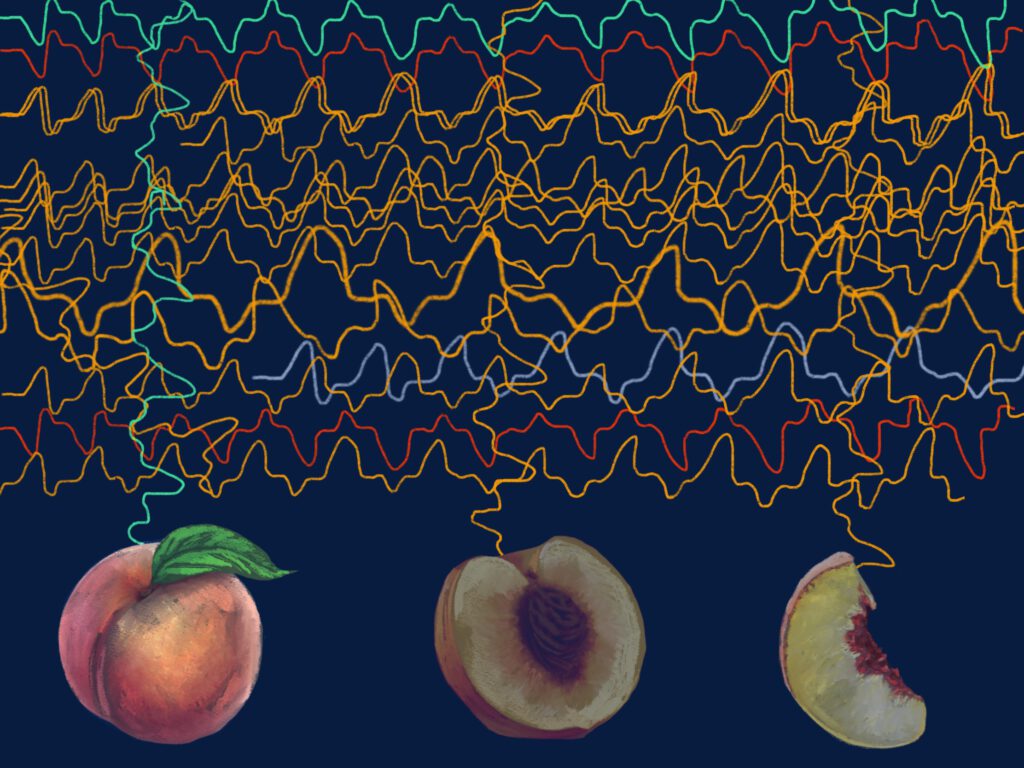
„Halleluja Junction“ by Sara Wittazscheck

In my 3 minute association phase, the following thoughts emerged:

  • Equal step
  • Minimal
  • Small steps
  • Dancing
  • Synchronous movement
  • Synchronicity
  • Confusion versus simplicity – chaos versus clarity
  • Waves
  • Parabolas 
  • Ups and downs
  • Reflection
  • Change despite staying the same – staying the same during change
  • Everything leads somewhere 
  • Setting references
  • Vertical versus horizontal
  • Sine curve 
  • Heartbeat
  • Repetition
  • Mere exposure effect
  • Stimuli
  • Senses
  • Taste
  • Smell 
  • Fruit
  • Still life
  • Sterility
  • Recurrence
  • Renaissance 

Topic Idea:

I had a conversation the other day. 

We talked about the future. 

Where do you see yourself in 5 years, he asked.

And my answer was: Here.

That probably came across as pretty uninspired. 

Anyway.

I asked myself the other day

„Who do I want to be in 5 years?“

And my answer was:

Whoever time has made me by then.

Does that seem kind of aimless now? 

I can’t tell.

So far, only a lyrical idea has emerged from this picture but no song idea yet.
20/33 Music-Drawers

20. Dezember 2021 by SaraW
Master Research

I was wondering the other day what inspiration and listening to music does for my composing. And I’ve found that I can divide the music I listen to into 3 different groups on an inspirational level:

There is the music that I can still listen to in the evening, even if the whole day has been about music. This is also the music that has a lot of atmospheric value for me and puts me in a nostalgic or meditative mood. But this music is specifically for listening! The kind of music I don’t want to analyse a chord progression and finally can stop thinking about my own demands or those of others.

Then there is the music that I admire. A melody that catches me, a form progression that surprises me, lyrics that tell the absolute truth or most beautiful story, harmonies that give me goosebumps on my arms and legs. Music that makes me a little angry about the fact that I didn’t come up with the idea myself. This is the music that I listen to so actively and intensively, as if I could transfer all these elements into my own writing. But often I have the famous fear of the blank page, when I intend to write music that has a similar effect on me. 

This is the „I wanna sound like“ category.

And then there is the music that makes me want to compose and immediately sit down at the piano. Often it has to do with the artists themselves, who just glow with such a loving and grounded handling with their music. It seems that mental alignment is a very crucial element when it comes to making inner sounds audible and tangible. 

When I improvise to my paintings I always notice that I simply have to decide to leave something as it is. To let ideas be as they want to left my head. Inspiration from sound rolemodels is important, but happens in advance. As soon as I follow it too much, I get a feeling of being restricted and wanting to force something. 

So I try to let that go.

My task for one of the next paintings: choosing music that is instrumental and that has more atmospheric value for me.

19/33 About Identity

12. Dezember 2021 by SaraW
Master Research

I’m having quite a hard time at the moment. There is hardly any time for my research work, as I am otherwise engaged in composing. I am taking two subjects this semester that are challenging, even overwhelming at times. Film composition with Leon Lhoëst and big band arrangement with Wolfgang Braun. Even though I have to be very disciplined and follow a tight schedule in order to get everything done, I already feel like I’ve really outgrown myself and learned even more than last year.

On the side, I’m writing the soundtrack for a friend’s short film and here I’m already reaching some personal as well as professional limits. I’m very proud of the results so far, but I also realize that I still have to and want to close some educational gaps in the field of music production. 

And with all this occupation with visuals, I realize again how much the motion picture animates me to write music and to give the depicted situation more depth and atmosphere.

The new experiences enrich me, and contribute to reflecting on my artistic identity and question my artistic self-image. Do I see myself as a jazz singer? From a cultural as well as a professional point of view, it is difficult for me to put this stamp on myself. 

More than that, though, I’m really starting to see myself as a composer. Sure it may be partly pandemic related, but my main occupation at the moment is to continue to develop my skills as a producer, writing lyrics and new music. When someone asks me what I do for a living, I feel authentic when I say that I am a vocal coach, singer and composer. And this realization gives me a lot of self-confidence and new drive right now.

18/33 Doing Changes Again…

2. Dezember 2021 by SaraW
Master Research

I had to think of my former teacher Reinette van Zijtveld-Lustig more often these days. When it came to finding an entrance into jazz improvisation, she asked me to imagine an empty room with a beautiful view. Now I should slowly fill it with my furniture and move one thing after another inside the room until I liked it. In the end, it was about the basic principle of creating, dealing, varying and adapting motifs… This technique of connecting improvisation with an everyday

example, easy to visualize in front of the inner eye, taught me a more unencumbered approach to improvisation than the theoretical, function-harmonic one did later. 

The last two painting processes have triggered a more realistic view of my previous approach, which I would now like to document in writing.

I would now like to consciously bring this decisive characteristic of improvisation, the further development of motifs, into my methodological approach. 

As soon as I no longer try to mirror a complete song in a visually perfect way, more intuitive creative processes emerge and I enter improvisation with a different attitude of expectation. I also find it easier to listen to myself while I’m busy processing the visual stimuli.

I select a part of the picture that illustrates the musical aspect that particularly catches my attention in the original composition.

During the further processing of the improvisation it becomes clear that no coherent song emerges from the improvisation. One idea follows the next and it resembles a collection of inspirational possibilities, which make it much easier to get started with the composition. 

When listening to the improvisation several times, ideas crystallize more and more clearly that were not identified as such in the affect. When I listen to the recordings with a little time distance, it almost feels as if a person from the outside is giving me new musical impulses that I can use for my current composition. 

16/33 Noa Kageyama’s Blog

25. November 2021 by SaraW
Master Research

Sabine Kühlich recommended a very good blog to me some time ago: Noa Kageyama’s The Bulletproof Musician. I discovered a post that talks about SMART goals. We talked about it in Your Art As A Business Module lesson and here the method is revisited, but in a slightly critical context. It highlights a study that evaluated, that setting open goals can have far more motivating and productive effects, if we are at a stage where we first plug in a framework for the things we set out to do. Instead of setting myself the goal of having 5 paintings done by the end of the year, perhaps it would be more purposeful to ask myself, how many paintings do I think I will get done by the end of the year? Maybe I will create more, maybe less but more impressive works that will inspire me to improvise? Maybe by then I’ll get to know new music that influences and inspires me…?

Not for all of us the SMART method is the right choice at all times.

Noa Kageyama addresses many interesting topics in his blog about practicing, resilience, confidence, focus, performance anxiety, etc. and talks with other musicians and experts. Maybe there are some interesting posts for you?

Follow this link to his site: https://bulletproofmusician.com/blog/

SMART goals vs. open goals: https://bulletproofmusician.com/specific-times-when-smart-goals-can-be-counterproductive-and-what-strategy-to-use-instead/

15/33 Gotta Be Another Way

15. November 2021 by SaraW
Master Research

Take a listen to the big band arrangement:

In the course of the painting process, I soon had to admit to myself that it is impossible to capture a piece of music from beginning to end in suitable colors, patterns and other fantasy shapes. I have now drawn the course of the melody of the chorus in a double line, which moves from the left edge of the picture to beyond the upper edge of the picture. The double line illustrates the repetition of the main motif. The white lines in the lower left quarter depict the movement of the melody of the bridge.

Trying to give my images something „readable“ and have my improvisations happen in our writing from left to right is basically a very logical approach. In the implementation, however, I quickly notice how arbitrarily I move across the picture in the process. I could assign the interval of a fourth to any line segment, or an Eb minor scale to the violet hue. If I try to read the picture less arbitrarily and stick exactly to given lines, I feel constricted.

Whenever too many possibilities open up to approach a thing, it is advisable to create anchor points. So I decide to go back to my approach on „Heaven in Pennies“ and give myself a simple, clear task. I took a closer look at the melodic concept of „Gotta Be Another Way“ and noticed that the sequence of notes in the chorus melody repeats itself raised a semitone, as well as the sequence of notes in the bridge recurs shifted down a whole tone. The piece is in itself strongly influenced by the element of modulation, so I set out to develop a melody line that remains the same in its interval sequence, but transposes upward. 

Below you can listen to the original improvisation as well as the further development of this idea.

I would like to make a general comment about the improvisations. Since some of the improvisations last several minutes, and may not be intended for public ears in their entirety, I have limited myself within this blog to isolating only the motif on which the subsequent song idea is based. The complete improvisations are available on request.

„Gotta Be Another Way“ by Sara Wittazscheck

The following associations have arisen with this work:

  • Nebula 
  • Vastness of the universe
  • Diversity
  • Incompatibility 
  • Repel from each other 
  • Be contrary
  • Layers 
  • Disturbance 
  • Brightness in the dark 
  • Contrariness 
  • Jagged
  • Inside turns outside and vice versa
  • Mediocrity
  • Border
  • Rebellion
  • Shield
  • Whirling
  • Parallelism
  • Be encroaching
  • Pushing boundaries
  • Getting closer to the unknown
  • Whirlpool

The following idea for a hook emerged from the above associations:

Live your mistakes awesomely

There’s no need for apologies

You don’t have to go down in history

Cheers on your mediocrity

„Gotta Be Another Melody (Motiv)“ by SAY.raw
„Cheers On“ by SAY.raw

14/33 Fixing My System

2. November 2021 by SaraW
Master Research

Ok. Animating is out. As well as my first approach to apply my method of transforming to different visualizations.

The process of visualizing existing music and use its outcome as a base for the creation of new music, still maintains to be the core of my work. While my previous attempt has been a rather intuitive and schematic approach, my very current thoughts deal with the question of repeatability within the first of the creative steps. The relation between the original song, the visualization and my composition must become visible and comprehensible. There must be at least a rudimentary relationship here.

Due to time constraints and the time consuming implementation, I decided to limit my analysis of selected songs to „paintings“. As before, I will work digitally with the Apple iPad including Apple pencil with the software Procreate.

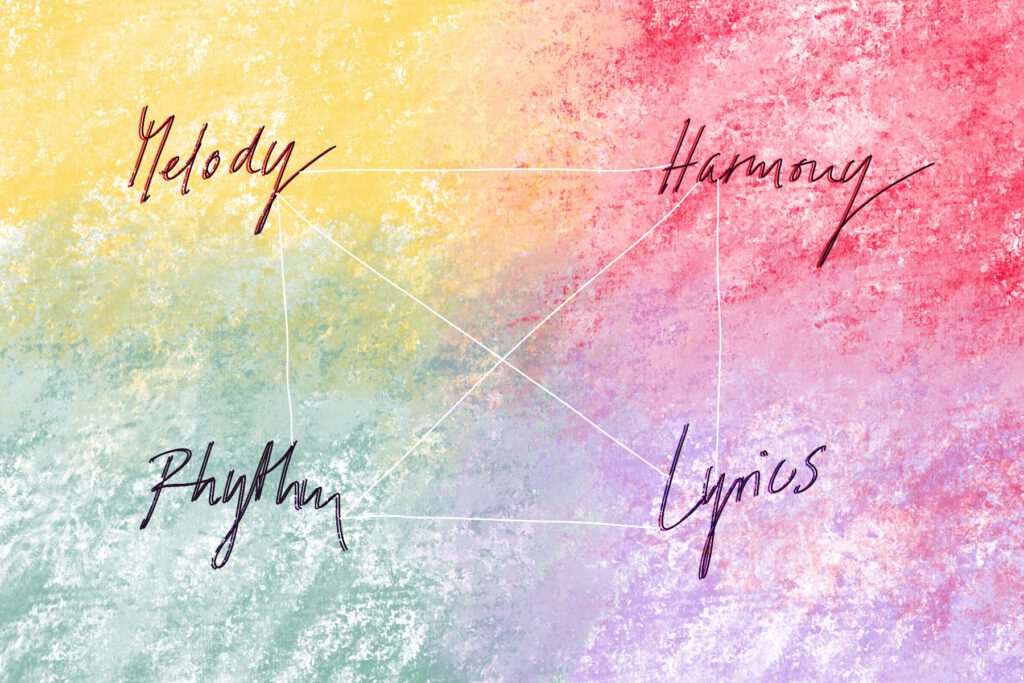
I intend to establish a fixed visual scheme or pattern for the 4 basic elements of harmony, melody, rhythm and lyrics. The harmonies are represented as colored areas. From a subjective point of view I would assign bright and/or warm colors to the major tonalities, dark and cool colors rather to the minor spectrum. Changes in the color gradient refer to harmonic changes or modulations. The melody is made visible as a white (salient) line that stands out clearly from the color background. The rhythmic element seems to challenge me quite a bit – how do you emphasize movement in a motionless image without a notated language? For now I decide to interpret patterns that arise during the painting process as rhythmic information. The development of the lyrical element is already established by a three-minute „association session“ following the completion of the painting.

Now the third step of the method follows – improvisation. I do not want to limit myself here on an artistic level and do not commit myself to purely vocal improvisation. I plan to implement other improvisations in a later stage by adding piano and doing a rough pre-production.

Based on my learnings so far, I would reformulate my scientific question as follows:

Composing based on visual arts. How creativity is gained from a process of transformation. (A self-experiment)

An overview of the songs I chose for my experiment until now:

The song I chose for video visualization is:

  1. Heaven in Pennies (Esperanza Spalding) 

For song visualization in form of a painting, I chose the following:

2. I heard you singing (Jacob Collier and Becca Stevens) -> completed

3.  Gotta be another way (KNOWER with wdr Big Band)

4.  Sing To the Moon (Laura Mvula with Snarky Puppy)

5.  In my Bones (Jacob Collier (feat. Kimbra + Tank and The Bangas)

6.  In The Stone (Earth Wind & Fire)

…. more to come!

13/33 Checking Out „Blender“

26. Oktober 2021 by SaraW
Master Research

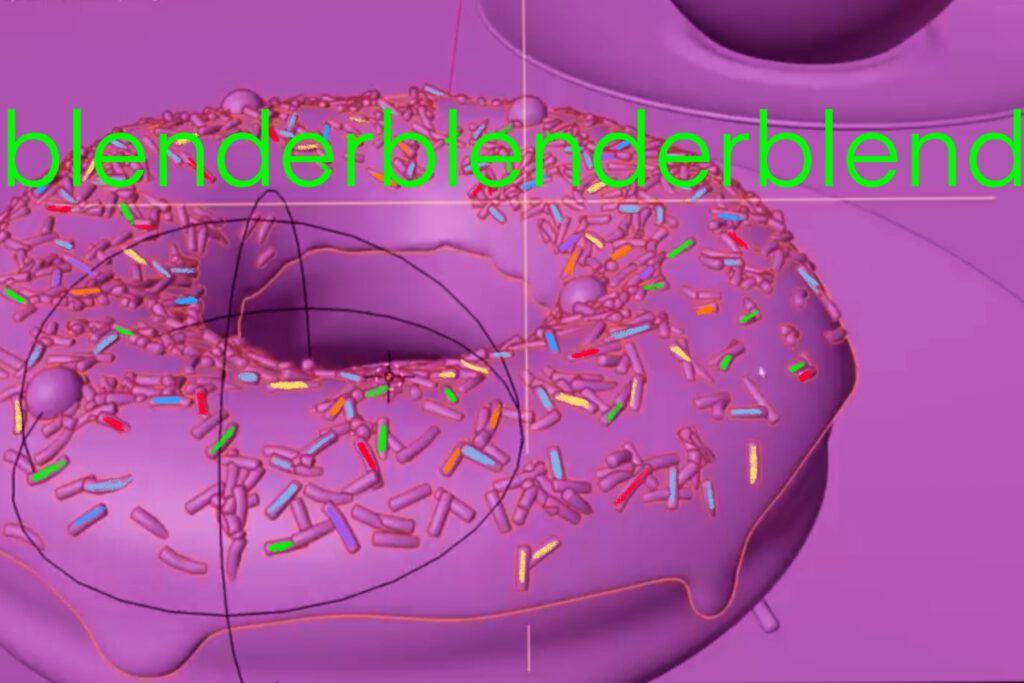
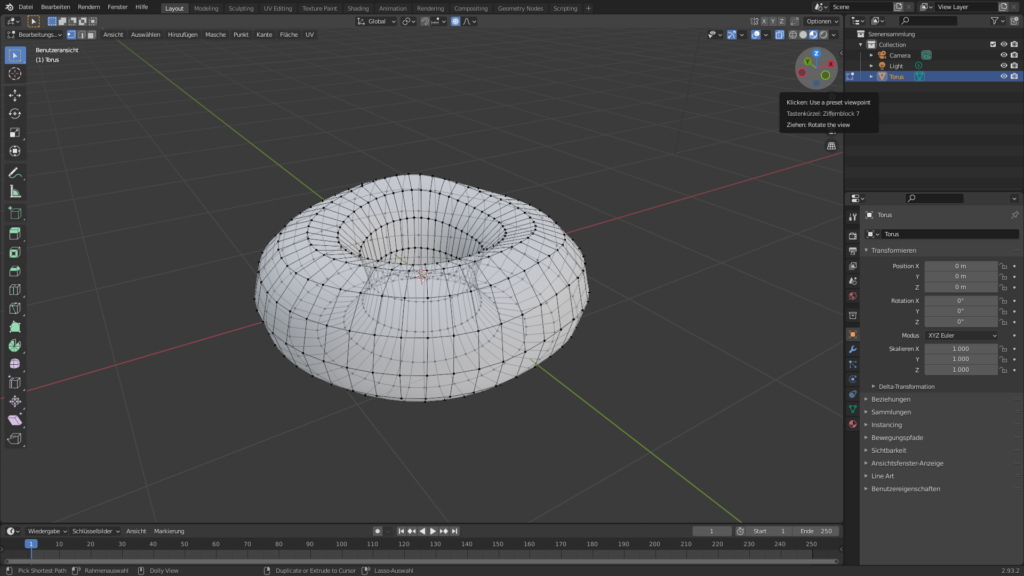
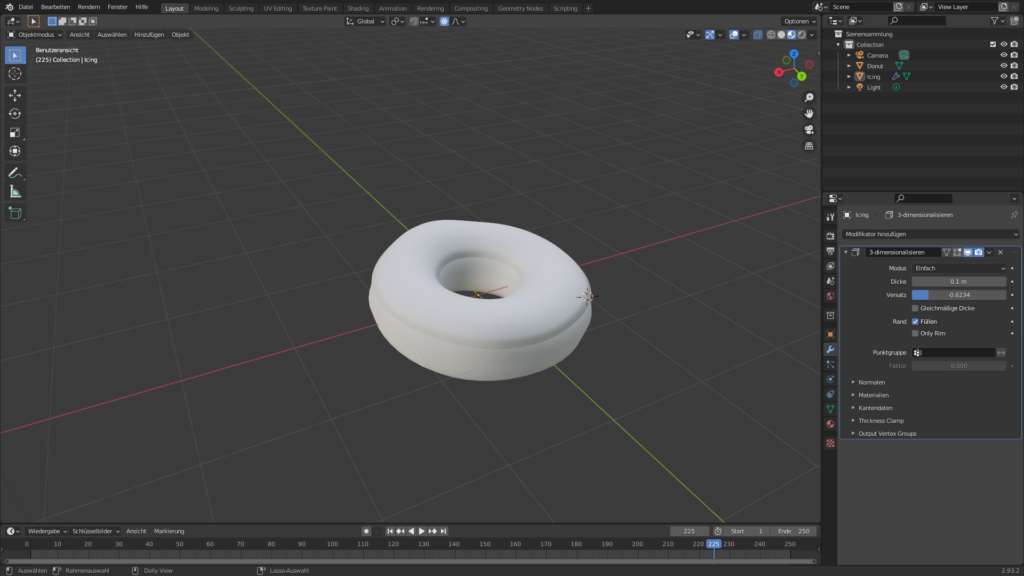
I am currently more involved in creating music videos, the desire to animate by myself and enhance my abilities  takes more and more shape. Now I face the challenge by acquiring skills on using the open-source software Blender with the help of a tutorials. Within the first minutes of this learning process, I already noticed that the reality is once again more complex than the vague idea of a final outcome. The possibilities of this program are endless. It will probably take me weeks to learn all the shortcuts by heart. I’ve started modeling a donut and probably with a little more time and focus it will become a cool project – „checking out Blender“. For now, however, I’ve abandoned the experiment…

Didn’t I actually want to compose something?

donut 1
donut 2

12/33 Creating Lyrics – Based On Colors And Patterns

19. Oktober 2021 by SaraW
Master Research

I had a chat with Helen about trends and anomalies during my composition process. Very often I start a composition with chords that come to me when I play the piano.  Above that, mostly wild improvising and searching results in the melody that has been waiting for the given chords. At the very end I’ve determined what message should be behind the music and have squeezed the words on the already existing melody with a lot of effort. 

With the latest songs I’ve written, I’ve turned it around. The words flowed from somewhere and I started composing with a clear idea of what my song wanted to say. The songs were finished faster and the compositions were more cohesive. 

In the actual case, I have already found melodic motifs to my painting and I’m asking myself: how do lyrics arise from a picture? What does it stimulate in me? Where are the connections between what I see and what I think? Maybe the first step should be to collect associations and then start improvising?

Helen has given me an exercise: collecting associations over 3 minutes that come to my mind when I look at my picture. This is what came out of it:

Fluffy

Interrupted

Unclear

Many things happen in parallel

against each other – with each other

Heaven on earth

Veiled

Warm

Open/wide

Upside down

Soil

Continuous

Where am I going? Why do I put the focus on the background? I am overlooking the main element -> Framed

11/33 What Does Improvisation Mean To Me?

10. Oktober 2021 by SaraW
Master Research

I’ve been thinking more about what improvisation actually means to me. It suddenly took on a new meaning in terms of „finding melodies“. I never really saw improvisation as separate from the jazz context. Always based on the changes of a jazz standard and with an academic approach, through which I got to know improvisation a few years ago.

There’s a pressure behind it to sing the right notes. And that singing right notes is not enough. It should be advanced and unprecedented at best. At least that’s the impression I got from my bachelor studies. I ignored the fact that I also improvise whenever I sing my own melodies over my favorite songs. That humming previously unsung melodies is also improvisation or varying an already existing melody. 

I think this is very much about renewing my approach to improvisation and taking away some of the dusty, unhealthy beliefs that I’ve collected and left untouched over the years…

10/33 Impro Lesson With Susanne Schneider

4. Oktober 2021 by SaraW
Master Research

I now come to the second creative step on the way to my own composition. I have sung several improvisations to my picture. At the beginning there was no particular procedure, I simply let my intuition run free, let colors and patterns work. One improvisation became longer than the other, one more rhythmic, the other searching for words. 

Then I asked myself whether it would be possible to create a repeatability within the improvisation. For example, through an improvisation that is oriented from the left side of the picture to the right. Or one that chooses a certain section of the picture as the main motif.

I noticed that I bypassed or „sang around“ the main pictorial motif – the door – each time. Somehow this part seemed too concrete to me to weave it into the Impro. Perhaps I would get other ideas if I changed the instrument? If the door were my main point of reference, would I play an improvisation on the piano?

I brought my drawing and ideas to the lesson with Susanne Schneider and recorded two nice improvisations there. 

In fact, a pretty musical motif emerged through a combination of „singing from left to right“ and focusing on a particular painted pattern to which I aligned pitch and movement of my singing.

Susanne gave me some important impressions along the way. I should not want too much at once –  better take my first idea and develop it in some directions. To be convinced and formulate the idea with all expressiveness. Represent the idea and have the clear intention to give meaning to my cause.

Saying an unconditional YES to my own ideas. Feeling „grown up enough“ to support my idea, as well as my singing and musical ability.

I think I’ve underestimated how much inner empowerment it takes to improvise….

9/33 Melissa McCracken – Painting Music

27. September 2021 by SaraW
Master Research

During my research on the internet, I became aware of an artist who has a big repertoire of songs on her website, which she has interpreted in picture form. Her trademark is a certain spatula technique. I really enjoyed browsing through her „song list“ – there are many inspiring works of art there.

Take a look at her work:

https://www.melissasmccracken.com/song-list

« Next
Previous »

SARA WITTAZSCHECK – IMPRESSUM – DATENSCHUTZ